Skip to content

Math Gym

Mental Math for Competitive Exams: Complete Guide
All articles
examsGMATGRESATJEEcompetitive

Mental Math for Competitive Exams: Complete Guide

April 20, 2026· Math Gym Team

Every second counts on the GMAT. Every minute matters on the GRE. And reaching for a calculator on the SAT - even when allowed - costs time you can't afford.

Mental math isn't just a party trick. For competitive exams, it's a strategic advantage that can add 20-50 points to your quantitative score simply by reducing computation time.

Why Mental Math Matters on Exams

Most quantitative exam questions test reasoning, not arithmetic. But if you spend 30 seconds computing 18 x 15, you have 30 fewer seconds to think about the actual problem.

The math:

  • Average exam: 37 quantitative questions in 62 minutes
  • Time per question: ~100 seconds
  • If 60% of questions involve computation: 22 questions
  • Saving 15 seconds per computation: 5.5 minutes recovered

Those 5.5 minutes are 3-4 additional questions you can attempt or double-check.

Exam-Specific Strategies

GMAT Quantitative (31 questions, 62 minutes)

The GMAT doesn't allow calculators. Mental math is not optional - it's required.

Key skills:

  • Fraction ↔ decimal ↔ percent conversions (instant recall)
  • Estimation for Data Sufficiency (exact calculation often unnecessary)
  • Divisibility rules (is 2,478 divisible by 6? Yes: divisible by 2 AND 3)
  • Powers of 2, 3, and 5 through at least the 10th power

Common GMAT computation patterns:

  • Percent change: (new - old) / old x 100
  • Weighted averages: total value / total count
  • Rate x Time = Work: combine with reciprocals
  • Simple/compound interest calculations

GRE Quantitative (27 questions, 47 minutes)

The GRE provides an on-screen calculator, but using it is slow. Mental math is faster for most computations.

Key skills:

  • Quick comparison without exact calculation (Quantitative Comparison format)
  • Square roots of perfect squares through 225 (√225 = 15)
  • Ratio manipulation and proportion shortcuts
  • Statistical formulas: mean, median, standard deviation estimates

SAT Math (44 questions, 70 minutes)

The SAT allows calculator use on one section but not the other. Even on calculator-allowed sections, mental math saves time.

Key skills:

  • Slope calculations without graphing
  • Quick factoring of quadratics
  • Percent of a percent (20% discount then 15% tax)
  • Converting between fractions and decimals instantly

JEE Main & Advanced (India)

JEE tests speed as much as knowledge. With 90 questions in 180 minutes across three subjects, every shortcut matters.

Key skills:

  • Vedic math tricks (base method for multiplication near 100)
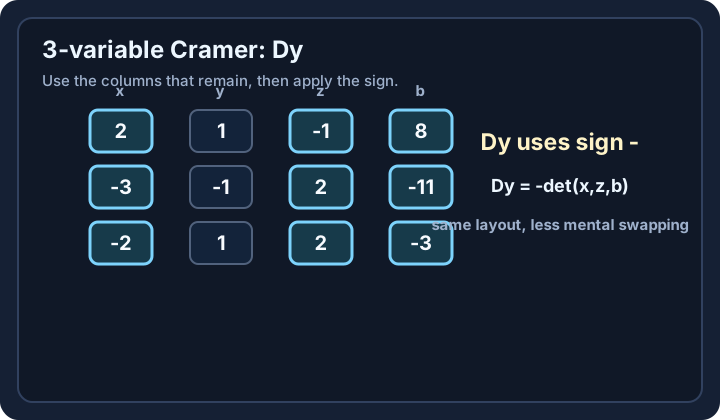
  • Determinant shortcuts for 3x3 matrices
  • Quick polynomial evaluation using Horner's method
  • Trigonometric value recall for standard angles

CAT Quantitative (India)

The CAT's quantitative section requires fast, accurate mental math across arithmetic, algebra, geometry, and number theory.

Key skills:

  • Number properties (remainders, factors, GCD/LCM)
  • Percentage ↔ fraction equivalents (1/7 = 14.28%, 1/11 = 9.09%)
  • Ratio-based solving (avoid algebra when ratios are cleaner)
  • Clock math and calendar problems

Universal Techniques

These work across all exams:

1. Build a Fact Bank

Memorize these cold:

  • Squares from 1² to 25²
  • Cubes from 1³ to 10³
  • Common fraction-decimal conversions (1/3 = 0.333, 1/7 = 0.143, 1/8 = 0.125)
  • Powers of 2 up to 2¹⁰ = 1,024
  • Key percentages: 10%, 12.5%, 20%, 25%, 33.3%, etc.

2. Estimate First, Calculate Second

Before solving, estimate the answer's magnitude. This:

  • Catches order-of-magnitude errors
  • Eliminates 2-3 answer choices immediately
  • Guides your calculation approach

Example: "What's 389 x 22?"

  • Estimate: ~400 x 20 = 8,000
  • Any answer choice far from 8,000 is wrong
  • Exact: 8,558

3. Work With Friendly Numbers

Decompose hard numbers into easy ones:

  • 48 x 25 = 48 x 100 / 4 = 4,800 / 4 = 1,200
  • 36 x 15 = 36 x 10 + 36 x 5 = 360 + 180 = 540
  • 72 ÷ 8 = 72 ÷ 2 ÷ 2 ÷ 2 = 36 → 18 → 9

4. Use Answer Choices

On multiple-choice exams, you can often:

  • Back-solve from answer choices (plug in the middle option first)
  • Eliminate using digit sums or last-digit analysis
  • Use the spread of choices to calibrate your estimation

Training Schedule for Exam Prep

6 weeks before exam:

WeekFocusDaily time
1-2Build fact bank (squares, cubes, conversions)15 min
3-4Speed drills on exam-relevant operations20 min
5-6Full timed practice with computation tracking25 min

The goal is to make basic computation quiet enough that your attention stays on problem-solving.

Build the Computation Base

Start six weeks before the exam when possible. If the exam is closer, keep the same order and shorten the sets.

Use the practice categories that match your exam: arithmetic speed first, then algebraic manipulation, then mixed timed sets.

The goal is to stop losing thinking time to avoidable arithmetic friction.

We use cookies for analytics to improve your experience. Essential cookies for authentication are always active. Privacy Policy