5 Mental Math Tricks for Faster Calculations
Pick one shortcut and run a two-minute drill.
Try the shortcut
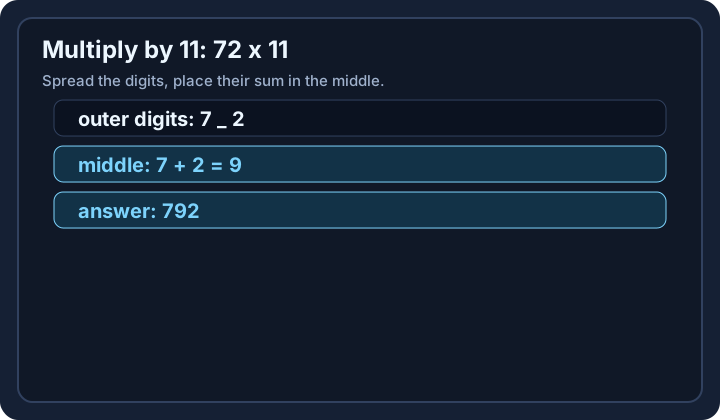
Multiply by 11 without a column setup
Keep the outside digits, add the middle pair, then carry only if needed.
- 1Place the first digit, 7.
- 2Add the two digits for the middle: 7 + 2 = 9.
- 3Place 2, then check against 72 x 10 + 72.
Why it works
Multiplying by 11 is multiplying by 10 and adding the original number once more.
Carry check
Bridge a sticky addition through ten
When the units feel crowded, complete ten first and carry only the leftover part.
- 1Use 3 from 8 to make 10.
- 2Keep the leftover 5 visible.
- 3Read 10 + 5 = 15.
When to use it
Use complements when a units carry is likely but the next ten is easy to reach.
Shortcuts are useful only when the first move is obvious.
Promise
Practice one pattern at a time: times 11, ending-in-5 squares, round-adjust, percentage flip, or subtract-by-adding.
Worked Example
For 85 x 11, keep 8 and 5, add the middle 8 + 5 = 13, carry 1 left, and read 935.
Mistake to Avoid
Do not collect five tricks and drill none of them. A shortcut becomes useful after repeated examples, not after reading the rule once.
Practice Drill
Choose one trick. Do ten examples, review misses, then stop before the method gets sloppy.
Recap
The useful part is reducing small pauses. Pick the matching category and stay on one level until the first move feels obvious.