How Number Theory Supports Cryptography
Connect primes and modular arithmetic to a real use case.
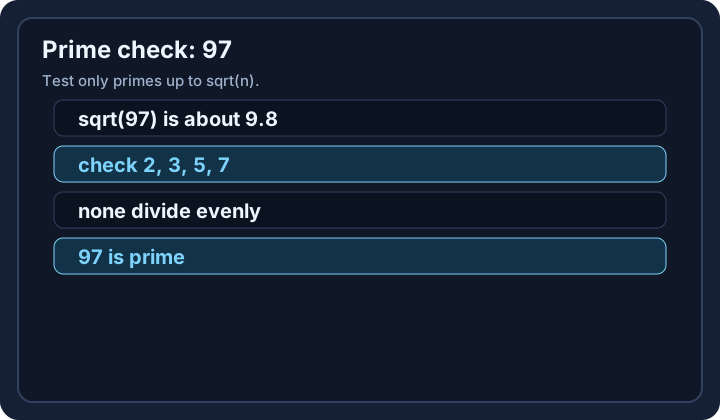
Prime check
Test factors only up to the square root
For a prime check, every large factor would have a matching small factor.
- 1Estimate the square root.
- 2Test primes up to that limit.
- 3If none divide evenly, the number is prime.
Why crypto cares
Large-number systems rely on multiplication being easy and factoring being hard at scale.
Remainder rule
Read divisibility through digits
Digit rules are small modular checks, not memorized trivia.
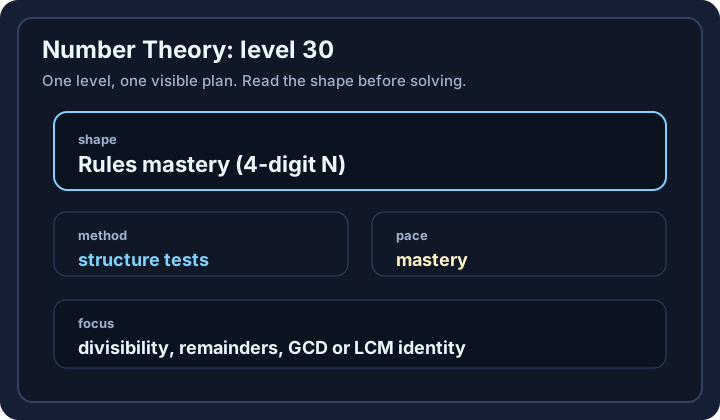
- 1Choose the divisor rule.
- 2Reduce the digits to a small check.
- 3Answer yes only when the remainder is zero.
Modular idea
Divisibility tests work because they preserve the remainder under a simpler expression.
Security systems use advanced math, but the first doorway is familiar: primes, factors, remainders, and modular arithmetic.
Promise
This page keeps the idea small. Multiplication can be easy while reversing the product into factors can be hard.
Worked Example
61 x 53 = 3233. Multiplying is direct. Factoring 3233 back into 61 and 53 is already slower by hand.
Mistake to Avoid
Do not treat RSA as all of cryptography. It is one classic example. Modern systems include other families and keep evolving.
Practice Drill
Factor 84, find the GCD of 84 and 126, then test whether 97 has any prime factor up to 9.
Recap
Number theory matters because it trains factor checks, divisibility, remainders, and the idea that some operations are harder to reverse.