Why zero was the most controversial number
For 1500 years, half the world refused to use it. The other half built calculus on it.
The problem with nothing
Ancient Greek and Roman mathematicians had no symbol for zero. To them, a number was a count of *something* - and you cannot count nothing. Try doing long division with Roman numerals and you will feel their pain.
India’s gift
In the 7th century, the Indian mathematician Brahmagupta gave zero arithmetic rules: a number minus itself is zero, anything times zero is zero, and - controversially - he tried to define division by zero (he got it wrong, but the question was right).
The European resistance
Zero arrived in Europe via Arab traders around 1200 CE. Florence banned it in 1299 - bookkeepers worried it could be forged into a 6 or a 9. Merchants used it in secret for two centuries before it was officially accepted.
Why it mattered
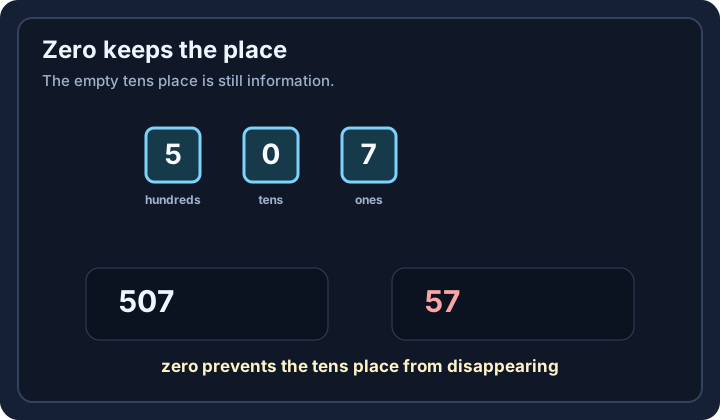
Without zero, there is no positional notation, no negative numbers, no algebra, no calculus, no computers. Every empty slot in your head when you do mental math is silently using a 1500-year-old idea that people once considered dangerous.